Snowdonia is the historical heart of British mountain trad climbing. The Llanberis Pass, Cwm Idwal, Tryfan and Lliwedd hold over a century of first ascents that defined modern trad — from the early Joe Brown and Don Whillans routes of the 1950s on the Llanberis cliffs to the Cromlech Boulders, the Idwal Slabs and the great Welsh winter gullies. Plus the Tremadog crags, the Anglesey sea cliffs and the Slate Quarries. More climbing per square mile than anywhere else in the UK.
At a glance
| What it is | The UK's most concentrated trad climbing area — the cultural heart of British mountain rock climbing |
| Main areas | Llanberis Pass, Cwm Idwal, Tryfan, Lliwedd, Tremadog, Gogarth (Anglesey sea cliffs), Llanberis Slate Quarries |
| Climbing style | Predominantly trad on volcanic mountain rock; sport climbing on quarried slate and at Tremadog; bouldering at the Cromlech Boulders |
| Season | May to September for summer trad; December to March for winter mountaineering on the higher cliffs (Lliwedd, Carneddau) |
| Grade range | Diff (Idwal Slabs Faith and Charity) through E10 testpieces; the broadest grade spread of any UK climbing region |
| Travel from London | 4-5 hours by car or train (London Euston to Bangor 3h 30) + onward bus or taxi to Llanberis |
| Cost | Free to climb at all natural crags; BMC membership recommended (~£50/year) for insurance and access representation |
Why climbing in Snowdonia is different
Three things separate Snowdonia from every other UK climbing region. First, the rock variety. Volcanic rhyolite on the Llanberis Pass and Tryfan, slabby dolerite at Idwal, slate at the Llanberis and Vivian Quarries, gabbro at Gogarth's South Stack, granite at the Holyhead Mountain sea cliffs. Each rock type carries its own technique, gear and style, all within an hour's drive of Llanberis.
Second, the multi-pitch tradition. Most UK climbing is single-pitch — Stanage, the Roaches, the lower Peak District crags. Snowdonia's main classics are multi-pitch routes on proper mountain cliffs: the Idwal Slabs are 200m of slab climbing in three or four pitches, Lliwedd carries the longest pure rock routes in Wales, and the Llanberis Pass routes (Cenotaph Corner, Cemetery Gates, Right Wall) are the standard intermediate progression into multi-pitch trad.
Third, the cultural weight. Welsh climbing is where Joe Brown and Don Whillans built their reputations in the 1950s; where Pete Crew and Dougal Haston ran the first British E grades; where Johnny Dawes redefined what was possible on slab in the 1980s. Climb the Llanberis classics on a clear summer day and you're climbing the routes that British climbing was built on.
The crags worth knowing in this guide
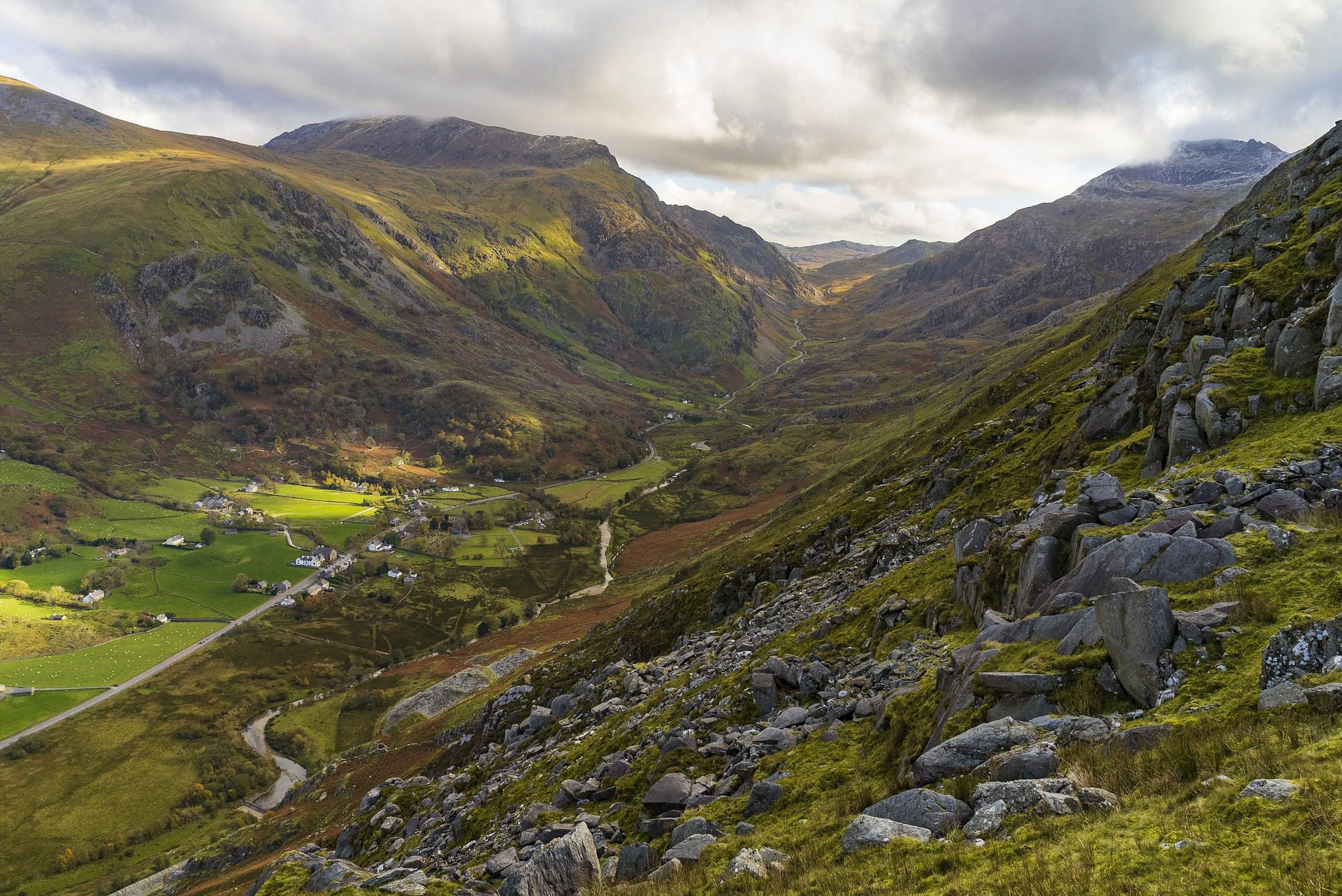
Snowdonia rock climbing — Snowdonia National Park
The mainstream Snowdonia climbing scene clusters around five areas: the Llanberis Pass (Dinas Mot, Dinas Cromlech, Carreg Wastad, Clogwyn y Grochan), Cwm Idwal (the Idwal Slabs, Glyder Fach Main Cliff), Tryfan (East and North Faces with the classic Grooved Arête), Lliwedd (the longest pure rock routes in Wales), and Tremadog (south-coast trad on Bwlch y Moch and Craig Pant Ifan).
Llanberis Pass — the historical heart
Dinas Cromlech holds the most famous routes in British climbing — Cenotaph Corner (E1 5b, first ascent Joe Brown 1952), Cemetery Gates (E1 5b, Brown 1951), Right Wall (E5 6a, Pete Livesey 1974). The corner-face geometry concentrates the line of weakness into a few dramatic features. Dinas Mot and Carreg Wastad offer easier Severe-to-VS trad on the same Pass. Walk-in from the Pass road is 15-30 minutes; all routes pull through the same rock type so technique transfers between crags.
Cwm Idwal — the beginner's classic
The Idwal Slabs are the standard introduction to Snowdonia multi-pitch trad. Faith, Hope, Charity and the Ordinary Route — all 200m, all in the HVD-Severe grade range, all on excellent grippy rhyolite slabs. The Cwm Idwal walk-in is 30-40 minutes from the Ogwen car park. Glyder Fach Main Cliff above adds harder routes (E1-E4) for stronger climbers.
Tryfan and the Glyderau — mountain climbing
Tryfan's North Ridge is a Grade 1 scramble that doubles as the standard introduction to Welsh mountain rock. The east face holds dozens of classic VS-HVS routes (Grooved Arête, Pinnacle Rib, Munich Climb). The summit involves a leap between the two summit blocks Adam and Eve — climbing it isn't legally required to count the day but it's the traditional finish. The wider Glyderau give bigger multi-pitch days for stronger parties.
Tremadog, Gogarth and the slate quarries
Tremadog (Bwlch y Moch, Craig Pant Ifan) gives short multi-pitch trad on south-facing crags 30 minutes from Porthmadog — a year-round option when the higher mountain crags are wet. Gogarth on Anglesey is the UK's biggest sea-cliff trad venue, with serious atmospheric routes from VS to E10 on quartzite and shale. The Llanberis Slate Quarries (Vivian, Australia) carry the country's best slab and slate sport climbing — bolted, quarried, technical.
How to choose the right Snowdonia climb for you
First proper Snowdonia trad route?
The Idwal Slabs Ordinary Route or Faith (both Severe-grade multi-pitch). Walk-in is 35 minutes from Ogwen; the rock is excellent; the climbing follows obvious lines on featured rhyolite slabs. A standard trad rack (set of nuts plus a small Friend set) is all you need. Most BMC-affiliated Snowdonia climbing schools run guided Idwal weekends.
Want the historical classics?
Cenotaph Corner (E1 5b) is the most famous trad route in the UK. If E1 is at the top end of your grade, take a strong second and prepare for committed climbing on small gear. For the same area at gentler grades, try Cemetery Gates (E1 5b) or Spiral Stairs (V Diff). Llanberis Pass climbing assumes you've done multi-pitch routes already.
First UK sea-cliff climb?
Tremadog's Bwlch y Moch is the easier introduction — south-facing, dry, three-star Severe-to-VS routes including The Plum, Striptease and Christmas Curry. Gogarth on Anglesey is the harder grade-up — the Main Cliff has classic E2-E4 routes (Wall of the Evening Light, Mein Kampf) on sea-cliff rock. Both reward partners who've climbed multi-pitch trad before.
Bouldering or sport climbing day?
The Cromlech Boulders give a full circuit of V0-V6 problems on Llanberis Pass gritstone-equivalent — short, sharp problems, no rope needed. For sport, head to the Llanberis Slate Quarries (Vivian, Australia, Lost World) — bolted technical slate with F5-F8 routes. The Beacon Climbing Centre in Caernarfon handles indoor preparation.
Winter mountaineering day?
Snowdonia winter climbing runs roughly December to March in cold years. The classic winter routes are on Lliwedd (Slanting Gully, Heather Terrace), Cwm Idwal (Devil's Kitchen ice), and the Northern Cwms of the Carneddau. This is proper Scottish-grade mixed climbing — ice axe, crampons, screws, the full alpine kit. Plas y Brenin runs the standard winter courses.
When to go: Snowdonia climbing by season
| April–May | Mountain crags start to dry. Tremadog and Anglesey workable earlier. Long evenings beginning. Trad season opens. |
| June–August | Peak season. Long daylight, settled weather windows, the popular classics busy. The Idwal Slabs and Llanberis Pass routes can queue at peak weekends. |
| September–October | The sweet spot. Crags dry, weather often more settled than midsummer, the historical classics quieter. October is the year's last reliable trad month. |
| November–March | Mainstream trad off-season. Winter mountaineering on Lliwedd and the Carneddau in cold years. Tremadog and the Llanberis Slate Quarries stay climbable in dry windows. |
Getting to Snowdonia climbing without a car
Bangor on the North Wales Coast Line is the nearest mainline railway station — London Euston to Bangor takes 3h 30. From Bangor, the Snowdon Sherpa S1 bus runs hourly into Llanberis and the Ogwen Valley in summer, less frequently in winter. The Snowdon Sherpa is the only way into Cwm Idwal and the Llanberis Pass crags without a car.
Many Snowdonia climbing trips combine the train + bus with a stay at the YHA Idwal Cottage or the Ogwen Cottage (Plas y Brenin), both of which sit at trailheads to the major crags. Llanberis village has B&Bs, cafés and the Beacon Climbing Centre — basing here works for car-free trips focused on the Llanberis Pass.
For Anglesey climbing (Gogarth, South Stack), the Holyhead-bound trains continue past Bangor; from Holyhead, taxis serve the cliffs. Tremadog is harder without a car — Porthmadog station (the Cambrian Coast line, 4h from Birmingham) is the closest, then a 15-minute taxi.
Where to base yourself
Llanberis: The natural base for the Llanberis Pass, the Slate Quarries and Snowdon-area routes. Pubs, B&Bs, supermarkets, the Beacon Climbing Centre, the Vaynol Arms (the local climbers' pub for 50 years). Closest mainline station: Bangor via S1 bus.
Ogwen / Capel Curig: The base for Cwm Idwal, Tryfan and Glyderau climbing. YHA Idwal Cottage and Plas y Brenin both sit on the A5; both run residential climbing courses. The walk-ins to Cwm Idwal and Tryfan start from these doorsteps.
Tremadog / Porthmadog: For the Tremadog cliffs and access to the Cambrian Coast Line. Smaller, quieter, the south-Snowdonia gateway. The Eric Jones Café below the Tremadog crags is the standard daytime climbers' hangout.
The wider Hiking in Snowdonia umbrella covers the walking and access patterns; the Mountain Biking in Wales umbrella has Coed y Brenin within 90 minutes for cross-discipline weekends.
Kit specific to Snowdonia climbing
Trad rack: a set of nuts (8-10 sizes), a set of Friends or equivalent cams (sizes 0.3 through 3), a half-rope set (most multi-pitch trad routes here run double-rope), a 60m abseil rope for retreat, the standard helmet-and-belay-device kit. For the bigger routes (Lliwedd, Tryfan), carry a hill-walking pack with food, water and emergency shelter — these are mountain routes with mountain-environment exposure.
Slate climbing kit: 10mm dynamic single rope, quickdraws (slate routes are usually 25-35m with 8-15 bolts), helmet. Sport climbers visiting from harder limestone areas should be aware that slate friction works differently — smear-heavy techniques and good footwork matter more than upper-body strength.
Welsh weather kit: a waterproof shell that compresses small enough to live in a chalk bag, a midlayer that handles the temperature swing between sunlit and shaded faces, and an awareness that a forecast-dry day can flip in two hours. The Met Office Mountain Weather Service publishes a daily Snowdonia forecast.
Common questions about rock climbing in Snowdonia
Where is the best rock climbing in Snowdonia?
The Llanberis Pass is the most-climbed area in Snowdonia — Dinas Mot, Dinas Cromlech and the Cromlech Boulders give you everything from V0 boulder problems to multi-pitch E-grade trad. Tryfan and the Glyderau (the Idwal Slabs, Cwm Idwal) carry the easier multi-pitch routes that introduce most British climbers to mountain trad. The Ogwen Valley sits between them and is the standard accommodation base. Beyond the classic trad areas, Holyhead Mountain on Anglesey gives short, accessible sea-cliff routes.
Can a beginner climb in Snowdonia?
Yes — the Idwal Slabs in Cwm Idwal are the standard introduction to multi-pitch Snowdonia trad climbing, with classic routes like Faith and Charity at HVD-Severe. The Llanberis Pass also has accessible single-pitch areas (Cromlech Boulders, the lower Dinas Mot routes). Most beginner climbers come through one of the BMC-affiliated climbing schools based around Llanberis or Capel Curig, which can run an introductory weekend with kit included.
When is the best month to climb in Snowdonia?
May, June and September deliver the most reliable Snowdonia climbing weather — long daylight, settled high-pressure systems, and the rock dry enough for trad climbing. July and August work but the popular routes (Idwal Slabs, Dinas Cromlech) get genuinely crowded. October offers the best autumn conditions but the days shorten quickly. November to March is winter mountaineering season — the trad cliffs are wet and cold, and the routes shift to snow and ice on the higher faces.
Is Snowdonia rock climbing trad or sport?
Almost exclusively trad. Snowdonia's climbing is the historical heart of British traditional climbing — placed-protection routes on natural rock, no bolts, the rope and rack carried up the cliff. The single-pitch crags around Tremadog and the Llanberis Pass have some sport bolts on quarried rock, and the Vivian and Australia slate quarries hold a separate bolted-slate scene, but the mainstream Snowdonia experience is trad.
Do I need a guide to climb in Snowdonia?
Not legally, but a guide is the fastest way in if you haven't climbed trad on mountain rock before. Snowdonia's mountain weather, route-finding and the placed-protection skill set all reward learning from someone with local experience. The BMC-affiliated mountain leaders and climbing schools (Plas y Brenin, Snowdonia Mountain Guides, Climb Snowdonia) all run guided days and multi-day courses. For pure single-pitch sport-style climbing at Tremadog, self-guided works for most intermediate climbers.
Where to climb
in Snowdonia.
Plan it yourself.
The most authoritative sources we know of for this crag — routes, conditions, governing bodies and operators. Open in a new tab.
- BMC British Mountaineering Council — the national body for climbing in England and Wales.
- BMC Regional Access Database crag-by-crag access status and seasonal restrictions (bird nesting etc).
- UKClimbing route database, conditions reports and the most active climbing forum in the UK.
- Mountaineering Scotland Scottish counterpart to the BMC.