Scottish climbing is the most varied and most committing in the UK. Glen Coe and Ben Nevis carry the country's biggest mountain trad cliffs; the Cairngorms hold the largest area of arctic-style winter mountaineering anywhere in Britain; Skye's Cuillin Ridge is the country's only proper alpine traverse; and the entire system sits under the Land Reform Act's right-to-roam access framework. Plus Glen Nevis sport climbing, the Lochnagar corries, and the sea cliffs of the north and west coasts.
At a glance
| What it is | The UK's biggest and most committing climbing region — proper mountain trad, world-class winter mountaineering, alpine-style ridges |
| Main areas | Glen Coe · Ben Nevis & Glen Nevis · Cairngorms (Cairn Gorm corries, Lochnagar, Cairn Toul) · Skye Cuillin · West Highland sea cliffs (Reiff, Stoer) |
| Climbing style | Trad rock in summer; technical mixed and ice in winter; alpine mountaineering on the Cuillin; minor sport climbing in the central belt |
| Access framework | Land Reform (Scotland) Act 2003 — general right of responsible bike and foot access to most non-cultivated land, including crags |
| Season | May to September for summer rock; late December to mid-March for winter mountaineering; Cuillin best June to early September |
| Grade range | V Diff (Curved Ridge on the Buachaille) through to E11 and Scottish VIII / IX mixed; the most committed UK climbing across both disciplines |
| Travel from London | Glen Coe / Fort William: 10h drive or overnight Caledonian Sleeper from London Euston. Cairngorms: 8h drive or train via Edinburgh + Aviemore |
Why climbing in Scotland is different
Four things separate Scottish climbing from English and Welsh equivalents. First, the scale. Ben Nevis is the highest mountain in the British Isles at 1,344m and carries the largest single rock cliff in the UK (the North Face, 600m of trad routes from Severe to E9). The Cairngorms hold a plateau of arctic-style mountain terrain unique in the country. Skye's Cuillin Ridge is a 12km traverse that takes most parties 18-24 hours on proper alpine ground.
Second, the winter season. Scottish winter mountaineering is the UK's only consistent alpine-style climbing — late December to mid-March in cold years gives full Scottish-grade ice and mixed climbing on Ben Nevis, the Cairngorms, Glen Coe and Creag Meagaidh. The Scottish Avalanche Information Service publishes daily forecasts for six main ranges; the BMC's MTUK conditions page tracks route conditions. No other UK region has anything comparable.
Third, the access law. Scotland's Land Reform Act 2003 grants the general public the right of responsible access on foot to most non-cultivated land, including crags and mountain cliffs. This is the most permissive climbing-access framework in the UK — England, Wales and Northern Ireland all rely on negotiated landowner agreements that occasionally restrict crag access. Scotland's Outdoor Access Code defines the responsibility expectations.
Fourth, the cultural weight. Modern winter mountaineering as a discipline was largely developed in Scotland in the 1960s and 1970s — figures like Hamish MacInnes, Tom Patey, Murray Hamilton and Andy Nisbet defined the techniques and the route ethics that still shape the sport globally. Glenmore Lodge, the Scottish National Outdoor Training Centre, is the spiritual home of British winter training.
The crags worth knowing in this guide
Glen Coe rock climbing — Glen Coe / Ballachulish
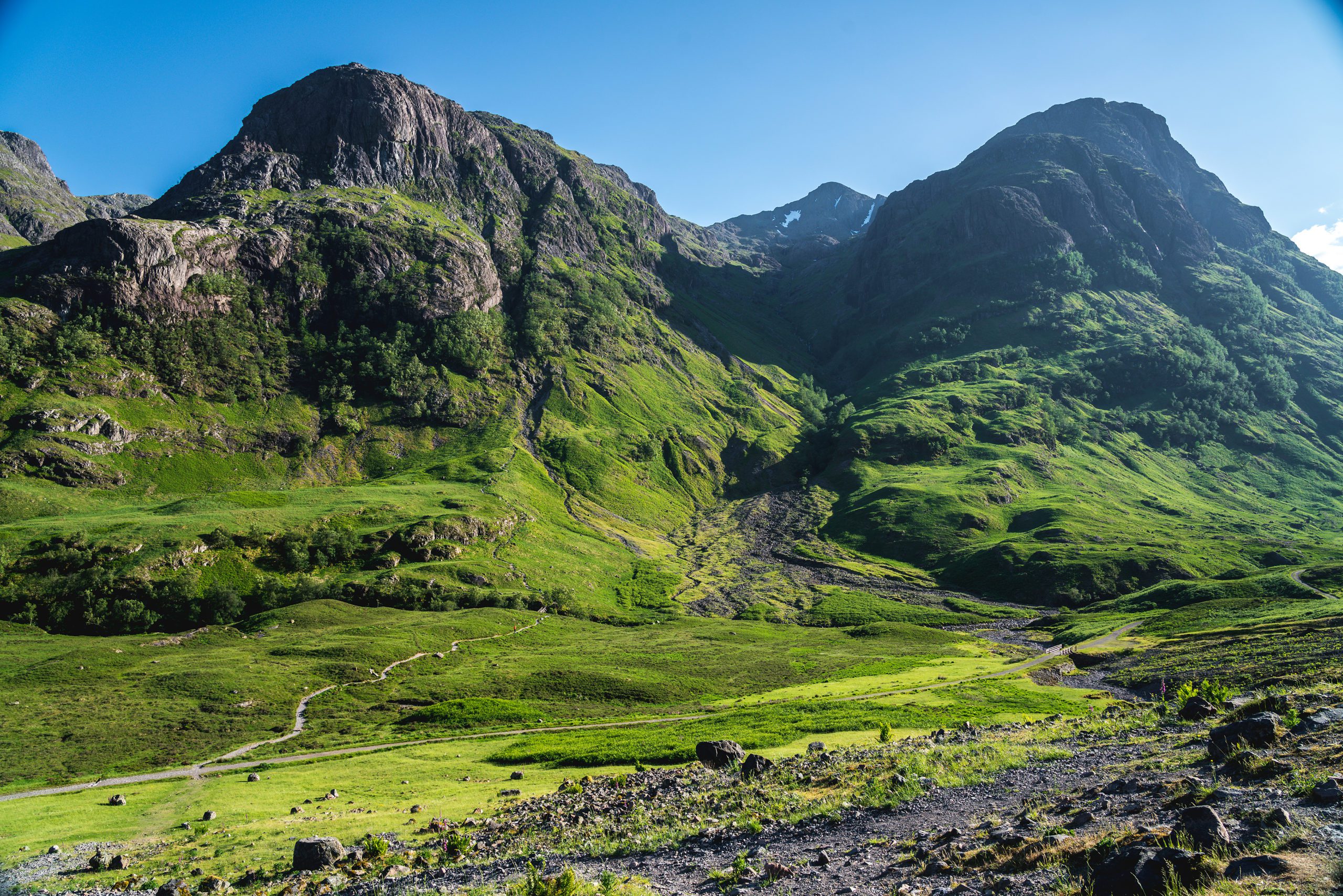
The cultural heart of Scottish climbing. The Buachaille Etive Mòr (the iconic pyramid summit at the head of the glen) carries Crowberry Ridge, Curved Ridge, Rannoch Wall and the harder modern routes (Carnivore, Trapeze). The Three Sisters (Aonach Dubh, Beinn Fhada, Gearr Aonach) hold the dramatic Aonach Dubh routes including E. The Aonach Eagach ridge above the glen is a 9km Grade 2 scramble. Walk-ins from the A82 are 30-90 minutes depending on the route.
Ben Nevis and Glen Nevis — the high cliffs and the gorge
The Ben Nevis North Face is the UK's biggest single rock cliff — 600m of trad routes from the Severe-grade Tower Ridge through to E9 modern testpieces. Tower Ridge, Observatory Ridge and the North-East Buttress are the classic summer multi-pitch ridges (5-8 pitches, mountaineering grade). Glen Nevis below the mountain offers shorter single-pitch trad on the Polldubh Crags (Diff-Severe-VS) and gorge sport climbing on the Polldubh Glen Nevis sport cliffs. Walk-ins from the Glen Nevis car park: Polldubh 20 minutes, Ben Nevis North Face routes 2-3 hours.
The Cairngorms — winter heart of UK climbing
The Northern Corries of Cairn Gorm (Coire an t-Sneachda, Coire an Lochain), Lochnagar on the eastern Cairngorms, and the Northern Corries of Braeriach hold the country's most reliable Scottish winter mountaineering. Routes range from Grade I (snow plod) through to Grade IX (extreme modern mixed). The walk-in to Coire an t-Sneachda from the Cairngorm Mountain car park is 45 minutes; the routes go up another 200-300m. Coire an Lochain on the same massif is the busier of the two. In summer, the Cairngorm granite slabs add easier trad options.
Skye Cuillin — the alpine ridge
The Cuillin Ridge is the UK's only proper alpine traverse — a 12km horseshoe linking 11 Munros across rough gabbro rock, including the iconic Inaccessible Pinnacle (a Difficult-grade rock pitch on the summit of Sgùrr Dearg). Most parties take 18-24 hours; some compete for sub-12-hour records. Individual peaks (Sgùrr Alasdair via the Great Stone Chute, Sgùrr nan Gillean) work as day-trip targets. Climbing routes on the Cuillin face include Cioch Direct, Integrity and Crack of Doom. Walk-ins from Glen Brittle are 90 minutes to 2 hours.
West Highland sea cliffs — Reiff, Stoer, Sheigra
The north-west Highland coast holds quieter, remoter sea-cliff trad climbing on Torridonian sandstone (Stoer Point) and gneiss (Reiff). Routes range from Diff to E5 on cliffs that mostly require abseil-in access. The walk-in from the nearest road varies by area; some involve genuine mountain approaches. These are dedicated trip-destinations rather than weekend afternoons — base in Achmelvich or Inverkirkaig and plan around the tides and weather.
How to choose the right Scottish climb for you
First proper Scottish mountain trad route?
Curved Ridge on the Buachaille Etive Mòr (Glen Coe, V Diff). The classic Scottish ridge mountaineering route — five pitches of easy rock scrambling on excellent rough rhyolite with brilliant exposure to the glen below. Walk-in 90 minutes from the A82. Most Glen Coe climbing schools (West Highland Mountain Guides, Glen Coe Mountain Guides) run guided Curved Ridge days.
Want to climb Ben Nevis?
Tower Ridge (V Diff) is the standard Ben Nevis multi-pitch — eight pitches up the North Face's right-hand ridge with proper mountain exposure. Allow 8-10 hours including the walk-in. For the harder Ben Nevis classics, Observatory Ridge and Centurion (E1) are the standard next-step routes. Winter climbing on the Ben (December-March) is a different discipline — full Scottish mixed climbing kit and skills.
Scottish winter mountaineering day?
Coire an t-Sneachda in the Northern Cairngorms is the standard introduction. The Goat Track (Grade I) is a snow plod with the avalanche-awareness skills required; the Aladdin's Couloir routes (Grade II/III) are the next progression. Always check the Scottish Avalanche Information Service forecast before committing. Glenmore Lodge in Aviemore runs the standard UK winter mountaineering courses — 5-day residentials covering rope, axe, crampon and avalanche skills.
Want to do the Skye Cuillin?
The standard Cuillin Ridge introduction is the Inaccessible Pinnacle alone — Difficult-grade rock with the spectacular position at the top of Sgùrr Dearg. Most parties hire a guide for the day (Skye Mountain Guides, Cuillin Guides). The full ridge traverse takes 18-24 hours and a full pack; the country's hardest mountaineering day-trip without a doubt.
Sport-climbing day?
Scottish sport climbing is limited but Glen Nevis Polldubh gorge has bolted limestone-equivalent (granite) routes from F5 to F8. Dunkeld in Perthshire has the country's best concentration of granite sport routes. For year-round bolted climbing, head south to the Lake District limestone or the Peak District limestone.
When to go: Scottish climbing by season
| April–May | Summer trad season opens. Low-lying crags (Glen Nevis Polldubh, Glen Coe valley routes) dry first. Mountain crags need late May to fully dry out. Long evenings. |
| June–August | Peak summer trad and Cuillin season. Long daylight (18 hours of useful light in June), settled weather windows possible. Midges become a serious factor from late June in the West Highlands — head net and DEET standard. |
| September–October | The sweet spot for summer trad — midges gone, weather often more settled, autumn colour, fewer crowds. The year's last reliable rock month. |
| November–March | Trad off-season but winter mountaineering season — late December to mid-March is the reliable Scottish winter window. Glenmore Lodge and Scottish Mountaineering Council run their winter programmes. The single most committing UK climbing season. |
Getting to Scottish climbing without a car
Glen Coe / Ben Nevis: The Caledonian Sleeper from London Euston runs nightly direct to Fort William (12 hours, arriving early morning). From Fort William, Stagecoach West Scotland 41 / N41 buses serve Glen Coe in summer. From Fort William town centre, walking to the Glen Nevis Polldubh crags is a 40-minute walk; the Ben Nevis North Face requires a 90-minute walk from Glen Nevis. The daytime ScotRail route via Glasgow Queen Street takes 5 hours from Glasgow.
Cairngorms: Aviemore is on the Highland Main Line — London Euston to Aviemore via Edinburgh takes 8 hours. Glenmore Lodge and the Cairngorm Mountain car park are both reachable by Stagecoach 31 from Aviemore. Most Cairngorm winter climbers stay at Glenmore Lodge or the Cairngorm Lodge YHA for direct access.
Skye: The Caledonian Sleeper to Inverness, then ScotRail to Kyle of Lochalsh (a beautiful 2-hour journey), then bus or taxi to Glen Brittle. Hardest to do without a car of all the Scottish climbing destinations.
West Highland sea cliffs: Effectively requires a car. The nearest railway stations (Garve, Ullapool by bus from Inverness) are 1-2 hours' drive from the sea cliffs.
Where to base yourself
Glen Coe / Ballachulish / Fort William: The Glencoe Mountain Resort base in Glen Coe village, the Clachaig Inn at the head of the glen (the historic climber pub), Fort William town for amenities and trains. All within 15 minutes of the Buachaille Etive Mòr trailheads and 20 minutes of Glen Nevis.
Aviemore / Coylumbridge / Glenmore (Cairngorms): Aviemore for amenities, restaurants and mainline rail; Glenmore Lodge for the dedicated climber base (full bunkhouse + course facilities); the Cairngorm Lodge YHA as the cheaper option. All within 15 minutes' drive of the Cairn Gorm car park.
Glen Brittle (Skye Cuillin): The campsite at Glen Brittle is the Cuillin base. The Sligachan Hotel at the head of the glen serves the eastern Cuillin. The Cuillin Hills Hotel in Portree is the most comfortable base but a longer drive. All within 30 minutes of the standard Cuillin walk-in points.
The Hiking in Scotland umbrella covers the wider Highland walking and the West Highland Way; the Mountain Biking in Scotland umbrella has Glentress and Nevis Range within reach for cross-discipline rest days.
Kit specific to Scottish climbing
Summer mountain trad: a full set of nuts (the Scottish granite and rhyolite take nuts well), a set of Friends (sizes 0.3 through 4), half-rope set, abseil rope, helmet, the mountain-day pack (food, water, waterproof shell, emergency shelter, headtorch). Scottish mountain weather can flip on you; the kit list assumes mountain-environment exposure even on a sunny day.
Scottish winter kit: 12-point crampons, ice axe (two for harder mixed routes), ice screws, helmet, the full waterproof shell + insulation layer + gloves + ski-mountaineering goggles. The Glenmore Lodge winter mountaineering course covers the kit list and how to use it in detail. Don't attempt Scottish winter climbing without the right kit and training.
Midges: from late June to early September, the West Highlands carry the worst midge season in the UK — Smidge or DEET-based repellent and a head net are standard. The Tweed Valley and the eastern Cairngorms are largely midge-free; the Glen Coe / Ben Nevis area is the worst-affected.
Common questions about rock climbing in Scotland
Where can I rock climb in Scotland?
Three main climbing scenes. Glen Coe is the cultural heart — the Buachaille Etive Mòr, the Three Sisters and the Aonach Eagach ridge offer everything from Severe trad to E-grade testpieces. Glen Nevis adds gorge and slab routes within walking distance of Fort William. The Cairngorms (Cairn Gorm corries, Lochnagar, the Northern Corries of Ben Macdui) carry the largest area of mountain trad in the UK. Skye's Cuillin Ridge is its own discipline — long mountaineering days on rough gabbro.
Is winter climbing in Scotland dangerous?
Yes — Scottish winter mountaineering is the most committing climbing discipline in the UK, with significant avalanche and weather hazards. Reliable winter conditions run from late December to mid-March in cold years; the Scottish Avalanche Information Service publishes daily forecasts for the six main ranges. Routes carry technical grades from I (snow plod) through IX (extreme mixed climbing on iced rock). The annual Scottish winter fatality count averages 4-6, mostly avalanche-related. Skills and judgement matter more than they do anywhere else in UK climbing.
What's the right to climb in Scotland?
Scotland's Land Reform Act 2003 grants the general public the right of responsible access on foot to most non-cultivated land, including crags and mountain cliffs. This is the most permissive climbing-access framework in the UK. The Scottish Outdoor Access Code sets responsibility expectations: keep dogs under control, respect stalking dates (typically August to October on Highland estates), and avoid disturbing nesting birds (March to July restrictions apply on several major cliffs).
Where can a beginner rock climb in Scotland?
Polldubh Crags in Glen Nevis hold a large concentration of accessible Diff-to-Severe trad routes with easy approach. Glen Coe's Etive Slabs (when dry) and the Lost Valley boulders are next-step destinations. The Cuillin of Skye is not a beginner destination — the navigation, exposure and route-finding are unforgiving. Most Scottish climbing schools (Glenmore Lodge, West Coast Mountain Guides) run intro courses and weekend trips that include kit and transport.
What's the difference between summer and winter Scottish climbing?
Two different disciplines wearing the same Scottish-climbing label. Summer (May-September) is dry-rock trad — gear placement, sticky rubber, the same skills as English crag climbing on bigger cliffs. Winter (late December-March) is snow-and-ice mixed climbing — ice axes, crampons, screw protection in ice or pin placement on iced rock. Most Scottish climbers do both but treat them as separate sports with separate kit and training requirements. Glenmore Lodge runs both summer rock and winter mountaineering courses through the year.
Where to climb
in Scotland.
Plan it yourself.
The most authoritative sources we know of for this crag — routes, conditions, governing bodies and operators. Open in a new tab.
- BMC British Mountaineering Council — the national body for climbing in England and Wales.
- BMC Regional Access Database crag-by-crag access status and seasonal restrictions (bird nesting etc).
- UKClimbing route database, conditions reports and the most active climbing forum in the UK.
- Mountaineering Scotland Scottish counterpart to the BMC.